CBAK Energy Reports Internal Sodium-Ion Cell Test Results and Outlines 12 GWh Capacity Plan
DALIAN, China, Sept. 17, 2026 (GLOBE NEWSWIRE) -- CBAK Energy Technology Limited (NASDAQ: CBAT) (“CBAK Energy” or the

Press Release Disclaimer: This is a press release distributed through the XPR Media network. It has not been independently verified by our newsroom.

DALIAN, China, Sept. 17, 2026 (GLOBE NEWSWIRE) — CBAK Energy Technology Limited (NASDAQ: CBAT) (“CBAK Energy” or the “Company”), a leading China-based lithium-ion battery manufacturer and energy solutions provider, today reported internal test results for its 32140 NH-7Ah full-tab sodium-ion cell and outlined a long-term plan for 12 gigawatt-hours (GWh) of annual sodium-ion battery production capacity. The planned production lines would be designed for compatibility with lithium-ion cell production, with deployment subject to customer qualification, commercial demand and implementation requirements. The sodium-ion program targets energy storage, light electric mobility and selected backup power applications. Internal tests at −40°C and 70°C, a 110°C span, highlight the cell’s potential for applications in varied climates and demanding operating environments. The cell uses sodium iron phosphate pyrophosphate (“NFPP”), an iron-based polyanion cathode material.
The sodium-ion program is intended to expand CBAK Energy’s battery portfolio and diversify its raw-material options. Sodium’s relative abundance may support more diversified sourcing and lessen sensitivity to lithium price volatility. The extent of any sourcing, cost stability or total cost of ownership benefits will depend on customer qualification, production scale, prevailing raw-material prices and performance at the system level.
Across these applications, the program evaluates charging performance, high-rate discharge, operation across a wide temperature range, cycle life, safety and cost against each application’s requirements. “Customers do not evaluate these attributes in isolation,” said Dr. Senlin Wang, Head of Sodium-Ion Battery R&D at CBAK Energy. “What matters is whether the cell’s overall performance matches the system design, duty cycle and operating environment of a specific application.”
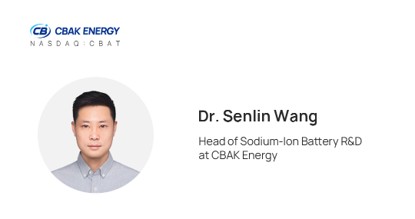
Dr. Senlin Wang, Head of Sodium-Ion Battery R&D at CBAK Energy
Fast Charging and Wide-Temperature Performance
The 32140 NH-7Ah cell combines an NFPP cathode with CBAK Energy’s full-tab design, which is intended to support high-current operation and heat dissipation. The cylindrical format provides flexibility for different pack configurations.
In internal laboratory testing under specified conditions, the cell reached a 90% state of charge within 15 minutes. During continuous discharge at 15C, capacity retention remained above 95%. The cell also demonstrated pulse discharge at 28C under the applicable internal protocol. Based on internal cycle-life testing and trend analysis, the cell is projected to deliver at least 10,000 cycles under the specified protocols.
In low-temperature discharge testing, the cell retained 87.68% of its discharge capacity at −40°C relative to its 25°C baseline. At the other end of the temperature range, internal testing at 70°C under a 1C/1C cycling protocol, combined with trend analysis, supports a projected cycle life of approximately 3,500 cycles to 80% capacity retention. Samples evaluated in the Company’s internal nail-penetration testing showed a high pass rate. Additional testing under specified protocols supported storage and transportation at a 0% state of charge. Together, these findings provide a cell-level performance profile relevant to applications involving frequent cycling, limited charging windows, high-power demand and demanding temperature conditions.
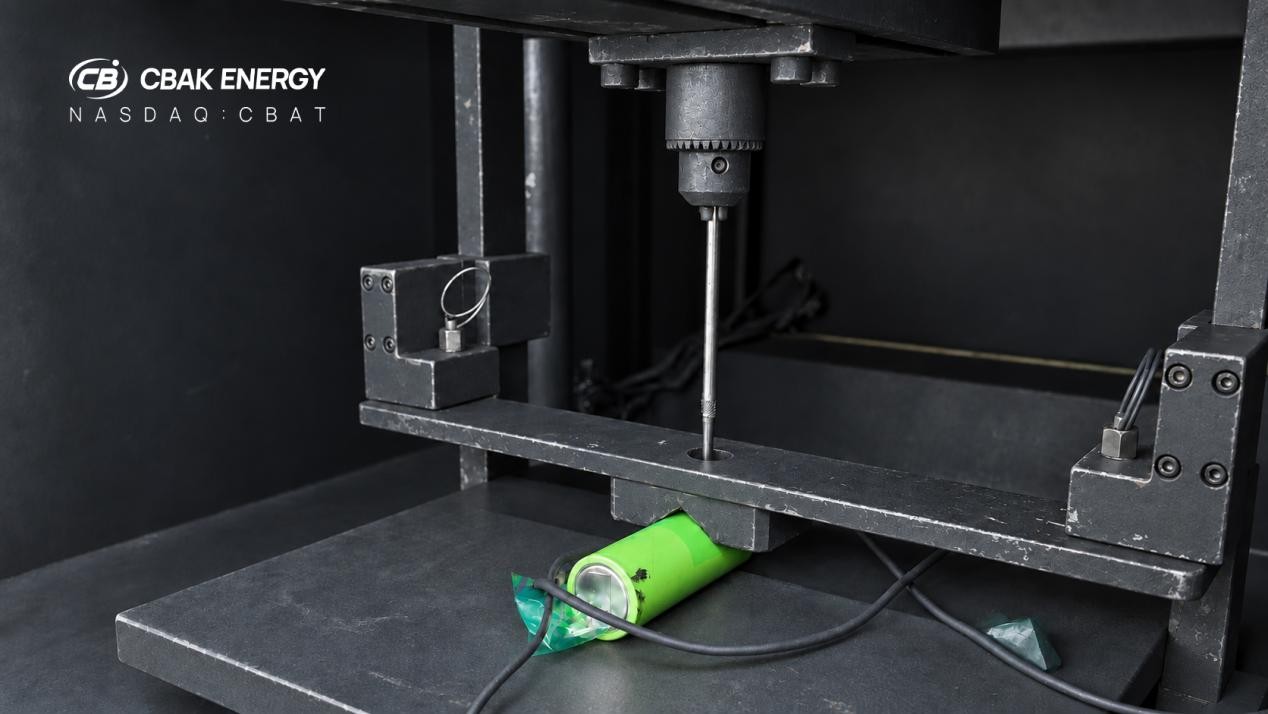
CBAK Energy’s 32140NH-7Ah sodium-ion cell undergoing internal nail-penetration testing.
Customer Sample Testing Across Multiple Applications
Customer testing of cell samples is underway in residential and portable energy storage systems and electric two- and three-wheelers. Additional evaluations cover specialty vehicles, start-stop systems and backup power applications. These programs examine how the cell performs within different pack designs, duty cycles and operating environments.
Feedback from this testing is guiding further work on charging performance, high-rate discharge and control of temperature rise. Because qualification requirements differ by customer and application, additional system-level testing may be required before commercial adoption.
12 GWh Capacity Plan with Lithium-Ion Production Compatibility
The Company’s long-term plan contemplates 12 GWh of annual sodium-ion battery production capacity. The planned production lines would be designed for compatibility with lithium-ion cell production. This design is intended to provide flexibility to respond to customer demand for either battery chemistry. The 12 GWh figure is a conditional planning objective and does not represent currently installed capacity. Customer qualification, commercial demand and implementation requirements will determine the timing and scale of deployment. The plan builds on CBAK Energy’s experience in full-tab cylindrical cell manufacturing, automated processes and established quality controls. Existing lithium-ion supplier relationships and a sodium-ion material supply chain provide an operational foundation for potential scale-up.
Future development plans also cover larger cylindrical formats, including 46- and 60-series cells, for higher-capacity applications, as well as specialized high-rate cells for emerging AI data center backup power applications. Technical validation and application requirements will determine the priorities and timing of these programs.
“We view sodium-ion as a complement to lithium-ion, with the strongest potential in applications where power, cycle life, performance across a wide temperature range and supply-chain flexibility must be balanced at the system level,” Dr. Wang said. “Our development plan links technical testing and customer qualification directly to decisions on performance priorities, cell formats and capacity deployment. This approach is intended to give customers a broader set of battery options while allowing CBAK Energy to scale in line with verified demand.”
The performance data and projections presented in this release are based on internal laboratory testing conducted by CBAK Energy under specified conditions and, where indicated, trend analysis. Actual performance, service life, cost competitiveness, total cost of ownership and other system-level results may vary depending on raw-material prices, manufacturing scale, system design, operating conditions and other factors.
About CBAK Energy
CBAK Energy Technology Limited (NASDAQ: CBAT) is a leading China-based high-tech company engaged in the development, manufacture and sale of high-power lithium-ion and sodium-ion batteries, as well as materials used in the manufacture of high-power lithium-ion batteries. The Company’s battery cell production, research and development, and sales operations are located in Nanjing, Dalian and Shangqiu. The Company also operates battery cell research and development centers in both Nanjing and Dalian. Its raw materials operations, including production, research and development, and sales, are headquartered in Shaoxing. The Company’s products and solutions serve electric vehicles, light electric vehicles, energy storage systems and other high-power applications. In January 2006, CBAK Energy became the first Chinese lithium battery manufacturer to be listed on the Nasdaq Stock Market.
Forward-Looking Statements
This press release contains forward-looking statements within the meaning of the safe harbor provisions of the U.S. Private Securities Litigation Reform Act of 1995. Forward-looking statements include statements regarding projected cycle life and other expected performance characteristics of the Company’s sodium-ion cells; continued development, customer testing and qualification, and potential commercial adoption; potential sourcing, cost stability and total cost of ownership benefits; the conditional long-term plan for 12 GWh of annual sodium-ion battery production capacity, the timing and scale of its deployment, plans to design the production lines for compatibility with lithium-ion cell production, and the intended flexibility to respond to demand for either battery chemistry; the ability of the Company’s manufacturing platform, supplier relationships and supply chain to support commercial scale-up; the development of larger cylindrical cell formats and specialized high-rate cells for AI data center backup power applications; and the potential role of sodium-ion batteries as a complement to the Company’s lithium-ion product portfolio. Forward-looking statements may be identified by words such as “expect,” “anticipate,” “believe,” “intend,” “plan,” “aim,” “project,” “may,” “will,” “could,” “should” and similar expressions.
These forward-looking statements are based on the Company’s current expectations and assumptions and involve risks and uncertainties that could cause actual results to differ materially from those expressed or implied. Such risks include differences between internal laboratory results, projected performance and actual performance in customer systems or commercial operating conditions; technical challenges in improving cell performance and safety and developing new formats; the timing and outcome of customer testing and qualification and whether they lead to commercial orders; changes in application requirements, customer demand, market acceptance and competing battery technologies; changes in raw-material prices and whether expected sourcing, cost stability or total cost of ownership benefits are realized; the Company’s ability to implement the planned compatibility with lithium-ion cell production, respond to demand for either battery chemistry and scale manufacturing while maintaining product quality, manufacturing yield, cost efficiency and operational reliability; the availability and cost of capital, raw materials, components, production equipment and qualified suppliers; the availability of facilities, required approvals and other resources for capacity expansion; the stability and development of the sodium-ion battery supply chain; changes in safety, transportation, environmental and other applicable laws, regulations or industry standards; macroeconomic and market conditions; and other risks described in the Company’s reports filed with or furnished to the U.S. Securities and Exchange Commission.
Readers are cautioned not to place undue reliance on these forward-looking statements, which speak only as of the date of this press release. Except as required by applicable law, the Company undertakes no obligation to update or revise any forward-looking statements, whether as a result of new information, future events or otherwise.
For more information, please visit: https://en.cbak.com.cn/
Email: marketing@cbak.com.cn
LinkedIn: https://www.linkedin.com/company/cbakenergy
X: https://x.com/CBAKEnergy
Stocktwits: https://stocktwits.com/CBAK_Energy
Investor Relations
Email: ir@cbak.com.cn
Website: https://ir.cbak.com.cn/
Photos accompanying this announcement are available at
https://www.globenewswire.com/NewsRoom/AttachmentNg/d5d66616-da8a-44e0-8bfd-e8e811e232bd
https://www.globenewswire.com/NewsRoom/AttachmentNg/1021c9ff-517d-4688-b801-289284d44fdc