Automotive Transmission Market to Reach USD 265.0 Billion by 2035, Growing at 4.72% CAGR
Automotive Transmission Market is projected to reach USD 175.0 Billion in 2026 before climbing to USD 265.0 Billion by

Press Release Disclaimer: This is a press release distributed through the XPR Media network. It has not been independently verified by our newsroom.
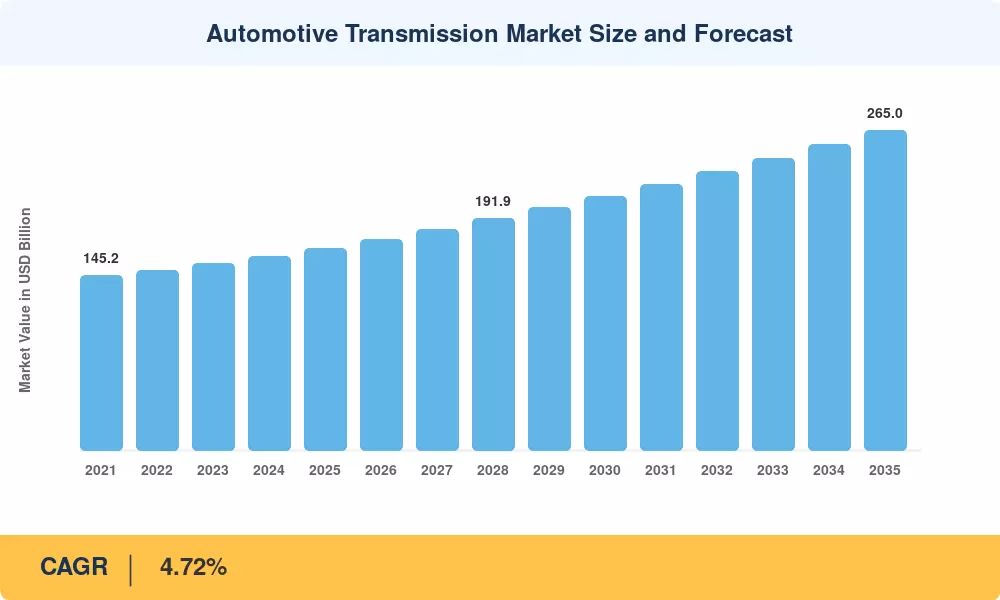

Automotive Transmission Market is projected to reach USD 175.0 Billion in 2026 before climbing to USD 265.0 Billion by 2035
NEW YORK, NY, UNITED STATES, August 21, 2026 /EINPresswire.com/ — Automotive Transmission Market to Reach USD 265.0 Billion by 2035, Growing at 4.72% CAGR
According to a study from Market Research Future, Automotive Transmission Market is projected to reach USD 175.0 Billion in 2026 before climbing to USD 265.0 Billion by 2035, expanding at a compound annual growth rate of 4.72% during 2026–2035.
Market Overview
The Automotive Transmission Market represents a cornerstone of the global automotive industry, encompassing all mechanical and electronic systems responsible for transferring power from the vehicle’s engine or motor to its driving wheels. Automotive transmissions are critical components that regulate torque and speed ratios, enabling vehicles to operate efficiently across diverse driving conditions, from highway cruising to stop-and-start city traffic and off-road terrain navigation. The market includes conventional automatic and manual transmissions, continuously variable transmissions (CVT), dual-clutch transmissions (DCT), automated manual transmissions (AMT), and intelligent manual transmissions (IMT), each offering distinct advantages in terms of performance, efficiency, and driving experience.
The market’s sustained growth trajectory is underpinned by several fundamental drivers. Global vehicle production continues to expand, particularly in emerging economies where rising disposable incomes and urbanization are fueling automobile demand. The increasing complexity of modern powertrains, driven by stringent emissions regulations and the push for improved fuel efficiency, has necessitated continuous innovation in transmission technology. Advanced transmissions with more gears, improved shift logic, and enhanced efficiency have become essential for automakers seeking to meet regulatory requirements while delivering the performance and refinement that consumers expect.
Several significant industry trends are reshaping the Automotive Transmission landscape. The most transformative trend is the electrification of vehicle powertrains, which is fundamentally altering transmission architectures and requirements. While traditional internal combustion engine vehicles rely on multi-speed transmissions to manage engine output characteristics, electric vehicles often employ single-speed or two-speed transmissions, with the latter emerging as a solution to balance acceleration, top speed, and efficiency in high-performance EVs. The hybridization trend has created demand for specialized transmissions that can seamlessly integrate internal combustion engines with electric motors, managing power flow between multiple sources while optimizing efficiency across different operating modes.
Technological developments in the transmission sector are advancing rapidly. Nine-speed and ten-speed automatic transmissions are becoming increasingly common, offering improved fuel economy and refinement through closer gear ratios and more efficient operation. Continuously variable transmissions have evolved significantly, with advances in belt and pulley technology and the introduction of stepped CVT designs that simulate gear shifts for a more traditional driving feel. Dual-clutch transmissions continue to gain popularity, particularly in performance-oriented vehicles, offering lightning-fast shifts and excellent efficiency. Intelligent manual transmissions represent an emerging technology that combines the engagement of a manual gearbox with automated clutch and shift actuation, providing drivers with control while eliminating the need for clutch pedal operation.
Government policies and regulatory frameworks exert considerable influence on transmission development. Fuel economy standards across major markets, including Corporate Average Fuel Economy (CAFE) regulations in the United States and CO2 emissions targets in Europe, have been primary drivers of transmission innovation. These regulations have incentivized the adoption of transmissions with more gears, improved efficiency, and integration with hybrid powertrains. Additionally, government incentives for electric vehicle adoption have accelerated the transition to electrified powertrains, influencing transmission development priorities toward EV-specific solutions.
The demand outlook for automotive transmissions remains robust, albeit with shifting dynamics as the industry transitions toward electrification. While automatic transmissions continue to dominate in mature markets such as North America and increasingly in Europe, manual transmissions maintain strong presence in developing markets and among enthusiast segments. The commercial vehicle segment represents a significant growth area, with heavy-duty transmissions evolving to meet the demands of improved efficiency, durability, and integration with advanced driver assistance systems. The aftermarket segment also presents substantial opportunities, driven by the need for transmission maintenance, repair, and replacement across the growing global vehicle parc.
📍 Get Free Sample Report for Detailed Market Insights:
https://www.marketresearchfuture.com/sample_request/2427
Market Segmentation
The Automotive Transmission Market is comprehensively segmented to provide detailed insights into the various aspects of this diverse and evolving industry.
By Transmission Type: The market encompasses Automatic transmissions, which dominate in many regions due to their convenience and refinement. Manual transmissions maintain significant market share, particularly in developing economies and among performance enthusiasts. Continuously Variable Transmissions (CVT) are widely adopted in small to medium-sized vehicles, offering excellent fuel efficiency and smooth operation. Dual Clutch Transmissions (DCT) provide rapid gear changes and high efficiency, making them popular in performance vehicles and increasingly in mainstream applications. Automated Manual Transmissions (AMT) offer a cost-effective solution for automated shifting, particularly in commercial vehicles and entry-level passenger cars. Intelligent Manual Transmissions (IMT) represent an emerging category that combines manual driver engagement with automated clutch operation, providing convenience without sacrificing the manual driving experience.
By Vehicle Type: The market is segmented into Passenger Cars, Light Commercial Vehicles (LCVs), and Heavy Commercial Vehicles (HCVs). Passenger cars constitute the largest segment, driven by the high volume of vehicle production and diverse consumer preferences across global markets. Light commercial vehicles are increasingly adopting advanced transmissions to improve fuel efficiency and driver comfort in delivery and service applications. Heavy commercial vehicles represent a critical segment where transmission durability, torque capacity, and integration with auxiliary systems are paramount considerations.
By Propulsion Technology: The market is categorized into Internal Combustion Engine (ICE), Hybrid (HEV/PHEV), and Battery Electric Vehicle (BEV) applications. Internal combustion engine vehicles continue to represent the largest segment, although their share is gradually declining as electrification advances. Hybrid vehicles require specialized transmissions capable of managing power from both internal combustion engines and electric motors, with architectures varying from parallel hybrid systems to series and power-split configurations. Battery electric vehicles typically employ single-speed transmissions, though two-speed transmissions are gaining traction in high-performance and luxury EV applications where enhanced acceleration and efficiency are desired.
By Sales Channel: The market is divided into Original Equipment Manufacturer (OEM) and Aftermarket segments. The OEM segment dominates, reflecting the integration of transmissions during vehicle assembly. The aftermarket segment provides replacement transmissions and components for vehicles requiring maintenance or repair, representing a stable revenue stream tied to the global vehicle parc.
🛒 You can buy this market report at:
https://www.marketresearchfuture.com/checkout?currency=one_user-USD&report_id=2427
Regional Analysis
North America represents a mature and substantial market for automotive transmissions, characterized by strong consumer preference for automatic transmissions and the presence of major domestic and international automakers. The United States leads the region, with pickup trucks and SUVs driving demand for heavy-duty automatic transmissions capable of handling substantial towing and payload requirements. The region’s regulatory environment, particularly CAFE standards, has incentivized transmission innovation, including the adoption of eight-speed, nine-speed, and ten-speed automatic transmissions that improve fuel efficiency without sacrificing performance. The growing penetration of hybrid and electric vehicles in the region is also shaping transmission demand, with specialized transmission solutions required for electrified powertrains.
Europe holds a significant share of the global Automotive Transmission market, reflecting the region’s position as a center of automotive engineering excellence. The European market is notable for the relatively high penetration of manual transmissions compared to North America, although the trend toward automation is clearly evident, particularly in premium and luxury segments. European automakers have pioneered dual-clutch transmission technology, which has become a hallmark of performance vehicles from the region. The region’s stringent CO2 emissions regulations have been a primary driver of transmission innovation, with manufacturers pursuing ever-more-efficient transmission solutions to meet regulatory targets.
Asia-Pacific represents the largest and fastest-growing market for automotive transmissions, driven by the region’s dominant position in global vehicle production and the rapidly expanding automotive markets in China and India. China, the world’s largest automotive market, has witnessed rapid adoption of automatic transmissions as consumer preferences evolve and domestic manufacturers improve their transmission offerings. Japan and South Korea, home to major automotive manufacturers, have been at the forefront of CVT and DCT development, technologies that have gained widespread adoption in the region. The rapid electrification of the Chinese automotive market is also influencing transmission development, with significant investments in EV-specific transmission solutions.
Rest of the World, including South America, the Middle East, and Africa, represents emerging markets with substantial growth potential. These regions are characterized by growing vehicle ownership, improving economic conditions, and increasing consumer demand for vehicle features, including improved transmission technology. The commercial vehicle segment is particularly important in these regions, where economic development drives demand for trucks and buses that require durable, efficient transmission solutions.
Competitive Landscape
The Automotive Transmission market features intense competition among a diverse range of global suppliers, including established transmission specialists, integrated automotive suppliers, and emerging technology companies. Key players include ZF Friedrichshafen AG, Aisin Corporation, Jatco Ltd, BorgWarner Inc., Eaton Corporation, Schaeffler AG, Magna International Inc., GKN Automotive, and others. These companies compete on factors including technological innovation, manufacturing scale, cost competitiveness, product quality and reliability, and relationships with automotive manufacturers.
Strategic developments in the market have been characterized by a significant focus on electrification and digitalization. Major transmission suppliers are investing heavily in developing transmission solutions for hybrid and electric vehicles, recognizing the fundamental shift in powertrain architectures. These investments encompass dedicated hybrid transmissions, integrated e-drive units, and electric drive systems that combine electric motors with single or multi-speed transmissions. The development of software and electronics for transmission control has also become increasingly important, with advanced control algorithms enabling improved efficiency, shift quality, and integration with vehicle dynamics systems.
Market positioning varies among players, with some companies focusing on specific transmission types or vehicle segments while others offer comprehensive transmission portfolios covering multiple technologies. The trend toward platform sharing and modular architectures has encouraged transmission suppliers to develop scalable solutions that can be adapted across different vehicle models and powertrain configurations. Strategic partnerships between transmission suppliers, automakers, and technology companies have become increasingly common, facilitating knowledge sharing and accelerating innovation.
Latest Industry News & Developments
Recent developments in the Automotive Transmission industry highlight the rapid pace of innovation and the strategic responses to evolving market demands. Major transmission manufacturers have announced significant investments in dedicated hybrid transmission platforms, reflecting the growing importance of hybrid vehicles in the global automotive market. These platforms are designed to seamlessly integrate internal combustion engines with electric motors while delivering the efficiency, refinement, and packaging benefits required for modern vehicles.
The industry has witnessed notable advancements in transmission control software, with machine learning algorithms being applied to optimize shift scheduling based on driving style, route conditions, and real-time powertrain operating parameters. These intelligent transmission control systems can adapt shift patterns to individual drivers, enhancing both performance and efficiency while providing a more personalized driving experience.
Another significant development is the increasing focus on transmission integration with vehicle electrification and automation systems. Transmissions are being designed as integral components of comprehensive vehicle energy management systems, coordinating with electric motors, battery management systems, and regenerative braking to optimize overall vehicle efficiency. The emergence of torque-vectoring transmissions, which distribute power between individual wheels to improve handling and stability, represents another frontier of transmission innovation.
Market Challenges & Opportunities
Despite the positive growth outlook, the Automotive Transmission market faces several significant challenges. The fundamental shift toward electric vehicles presents a structural challenge for traditional transmission manufacturers, as EVs typically require simpler transmission systems than internal combustion engine vehicles. This transition has the potential to disrupt established business models and requires substantial investment in new product development and manufacturing capabilities. The high cost of developing and manufacturing advanced transmissions with more gears or complex hybrid integration also presents challenges, particularly in cost-sensitive vehicle segments.
However, these challenges are accompanied by substantial opportunities. The growth of hybrid vehicles, which are expected to play a significant role in the transition to fully electric mobility, creates demand for specialized hybrid transmissions that can effectively manage multiple power sources. Two-speed transmission for electric vehicles represents an emerging opportunity, offering improved performance and efficiency compared to single-speed systems, particularly in high-performance and luxury EV applications. The aftermarket segment presents stable opportunities for transmission maintenance, repair, and replacement, supported by the growing global vehicle parc and the extended service life of modern vehicles.
Emerging markets offer significant growth opportunities, driven by expanding vehicle production and increasing consumer demand for advanced transmission technologies. The development of autonomous vehicles may also create new opportunities for transmission technology, as the integration of self-driving capabilities with powertrain control systems becomes increasingly important. The continued evolution of regulatory standards presents both challenges and opportunities, as manufacturers that can develop innovative, efficient transmission solutions may gain competitive advantages in meeting compliance requirements while delivering performance and refinement.
To explore more market insights, visit us at:
https://www.marketresearchfuture.com/reports/automotive-transmission-market-2427
Final Market Summary
The Automotive Transmission Market is poised for sustained growth, with projections indicating a rise from USD 175.0 Billion in 2026 to USD 265.0 Billion by 2035, reflecting a CAGR of 4.72%. This growth reflects the continued importance of transmission technology in the global automotive industry, even as the sector undergoes a fundamental transition toward electrification.
The long-term industry potential remains substantial, driven by ongoing innovation in transmission technology, the growing global vehicle parc, and the continued development of hybrid and electric vehicle markets. While the electrification trend represents a significant change for the industry, it also creates opportunities for transmission suppliers to develop specialized solutions for new powertrain architectures.
Looking ahead, the market is expected to evolve along a dual track, with traditional automatic and manual transmissions continuing to serve internal combustion engine vehicles, while dedicated hybrid and electric vehicle transmissions capture an increasing share of the market. The integration of transmission systems with vehicle dynamics control, driver assistance systems, and connectivity platforms will create new opportunities for innovation and value creation. The competitive landscape will likely see continued consolidation and strategic partnerships as companies seek to position themselves for success in an evolving automotive landscape.
More Related Reports from MRFR Library:
Automotive Braking System Market : https://www.marketresearchfuture.com/reports/automotive-braking-system-market-4166
3D Printing in Automotive Market : https://www.marketresearchfuture.com/reports/3d-printing-automotive-market-4207
Automotive Fleet Leasing Market : https://www.marketresearchfuture.com/reports/automotive-fleet-leasing-market-4328
Automotive Engine Management System Market : https://www.marketresearchfuture.com/reports/automotive-engine-management-system-market-4752
Electric Vehicle Battery Market : https://www.marketresearchfuture.com/reports/electric-vehicles-battery-market-4810
Automotive Pressure Sensor Market : https://www.marketresearchfuture.com/reports/automotive-pressure-sensor-market-4906
Automotive LiDAR Sensors Market : https://www.marketresearchfuture.com/reports/automotive-lidar-sensors-market-4942
Automotive Collapsible Steering Column Market : https://www.marketresearchfuture.com/reports/automotive-collapsible-steering-column-market-5132
Mountain Bikes Market : https://www.marketresearchfuture.com/reports/mountain-bike-market-5165
Automotive Air Suspension System Market : https://www.marketresearchfuture.com/reports/automotive-air-suspension-system-market-5293
Larry Wilson
WantStats Research And Media Pvt. Ltd.
+1 855-661-4441
email us here
Legal Disclaimer:
EIN Presswire provides this news content “as is” without warranty of any kind. We do not accept any responsibility or liability
for the accuracy, content, images, videos, licenses, completeness, legality, or reliability of the information contained in this
article. If you have any complaints or copyright issues related to this article, kindly contact the author above.

Media gallery