Vadzo Imaging Positions Falcon-544CRS AR0544 Low Power USB Camera for Reliable Outdoor, Retail, Automotive, and Industrial Vision
Vadzo Imaging announces the Falcon-544CRS, a purpose-built AR0544 low power USB camera engineered for sustained

Press Release Disclaimer: This is a press release distributed through the XPR Media network. It has not been independently verified by our newsroom.


Vadzo Imaging announces the Falcon-544CRS, a purpose-built AR0544 low power USB camera engineered for sustained reliable operation in thermally demanding and mechanically stressful field environments. Built on onsemi’s HyperLux LP AR0544 5MP image sensor and connected through a USB 3.2 interface, the Falcon-544CRS covers an extended operating temperature range of −30°C to 85°C. Embedded vision engineers and OEM developers working on outdoor surveillance infrastructure, automotive vision platforms and industrial inspection systems now have access to a compact USB interoperable imaging module that maintains consistent performance without thermal compromise.
FORT WORTH, TX / ACCESS Newswire / August 5, 2026 / Vadzo Imaging today published a technical overview of the Falcon-544CRS. The AR0544 belongs to onsemi’s HyperLux LP sensor family, a product line engineered to deliver low power consumption without sacrificing image resolution or dynamic range. In embedded system design, power efficiency at the sensor level has downstream consequences across the entire module. Reduced sensor power draw lowers PCB-level heat generation, which relaxes thermal management requirements in sealed enclosures and extends operational life in battery-backed or solar-powered edge nodes. As a low-power USB 3.2 camera, the Falcon-544CRS inherits this efficiency architecture and delivers it through a universally supported interface standard that integrates without proprietary drivers on Linux and Windows host environments.
What Sets the Falcon-544CRS Apart
Standard commercial USB camera products are typically rated from 0°C to 50°C at best. The Falcon-544CRS is a validated AR0544 extended temperature camera covering −30°C to 85°C, a thermal window wide enough for deployment across arctic field conditions, tropical outdoor infrastructure, and high-ambient industrial zones. As an automotive USB camera solution and a harsh environment USB camera, the Falcon-544CRS addresses a category that has historically been dominated by Gigabit Ethernet and Camera Link-based solutions requiring more complex host-side integration. The Falcon-544CRS brings extended temperature reliability into the USB ecosystem, enabling development teams already architected around USB host platforms to deploy without redesigning their imaging capture pipeline.
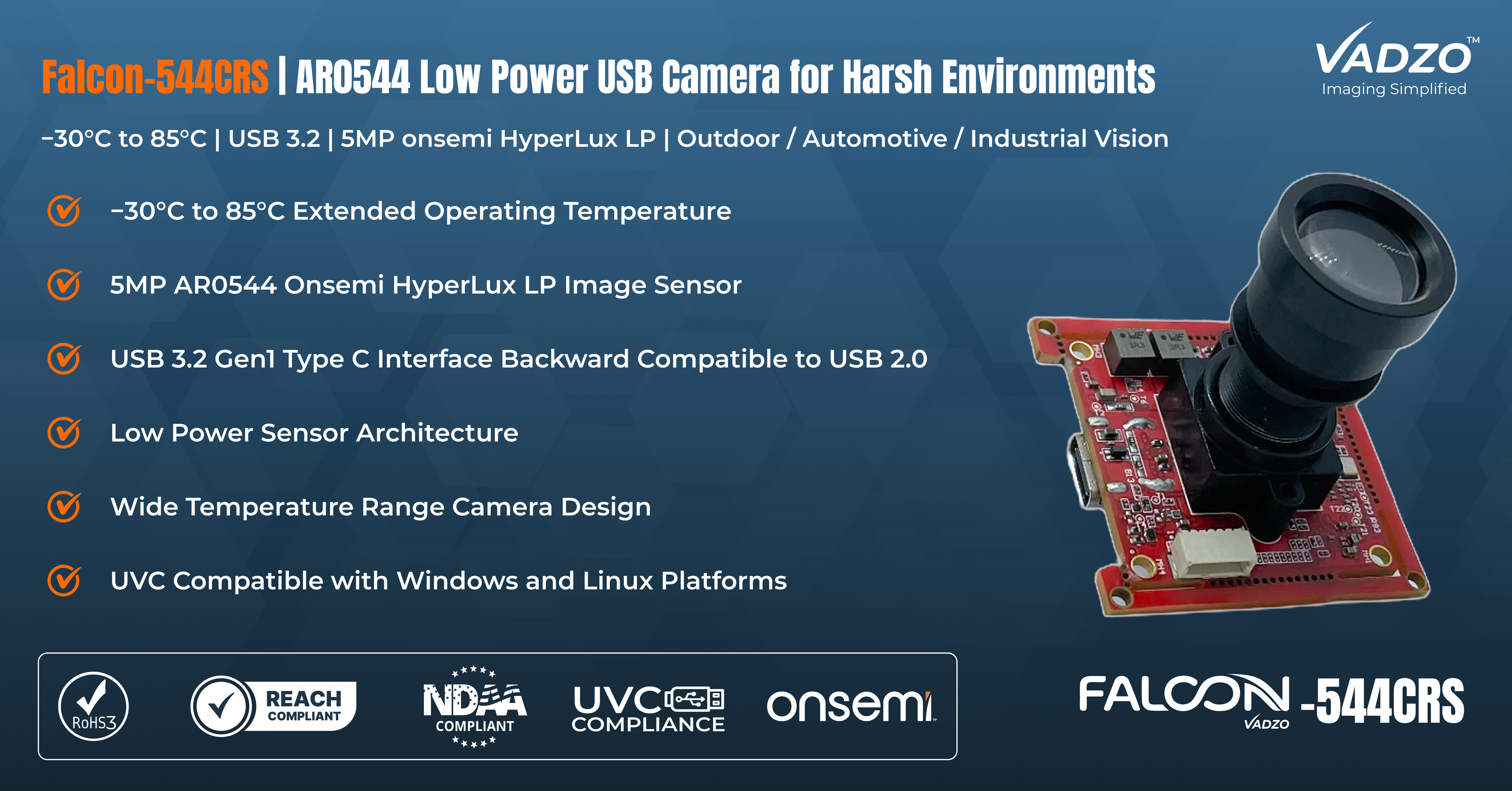
Product Specifications
|
Parameter |
Specification |
|
Sensor |
Onsemi HyperLux LP AR0544 |
|
Resolution |
5MP (2592 x 1944) |
|
Optical Format |
1/4.2″ |
|
Pixel Size |
1.4 µm |
|
Shutter Type |
Rolling Shutter |
|
Color / Monochrome |
Color |
|
Lens Mount |
S-Mount (M12) |
|
Focus Type |
Fixed Focus |
|
Interface |
USB 3.2 Gen1 Type C Interface Backward Compatible to USB 2.0 |
|
Output Modes |
5MP / 1080p / 720p / VGA |
|
OS Support |
Windows, Linux, and Android |
|
Driver Standard |
UVC Compliant |
|
Compliance |
RoHS 3 / REACH / NDAA |
“The Falcon-544CRS is a direct response to what we hear from engineers building outdoor and vehicle-mounted vision systems. They need the integration simplicity of USB with the environmental endurance of an industrial-grade module. The onsemi HyperLux LP USB Camera architecture gives them both without forcing a compromise on resolution or power budget.” – Alwin Vincent, Product Manager, Vadzo Imaging
Applications
Automotive ADAS and Vehicle Camera Integration: Modern ADAS platforms are structured around sensor fusion architectures that combine data from radar, lidar, and image sensors to support functions including Forward Collision Warning, Automatic Emergency Braking, Lane Departure Warning, and Lane Keeping Assist. An ADAS vision camera assigned to any of these perception functions must produce reliable image data across the full thermal envelope of the vehicle’s deployment environment. Euro NCAP’s expanded safety protocols now mandate Driver Monitoring System integration in new vehicle models, and ISO standards for occupant monitoring define performance thresholds that require consistent sensor output across seasonal temperature variations. A driver monitoring camera assigned to the cabin-facing occupant detection axis must operate in conditions ranging from below-zero cold soak temperatures at vehicle startup in northern climates to sustained high ambient conditions in tropical regions.
The Falcon-544CRS covers this thermal requirement with its −30°C to 85°C operating window. For vehicle camera module deployments supporting fleet management, ride-hailing supervision, or commercial trucking compliance, recording the extended temperature tolerance enables continuous imaging without thermal shutdown interruptions across intercontinental route profiles where climatic conditions vary significantly.
Traffic Monitoring and License Plate Recognition: Fixed roadside intelligent transportation systems deploy camera modules as the primary sensing element for vehicle detection, classification, and identification. A traffic monitoring camera installed at intersection control points, highway gantries, or border crossings must produce consistent frame output through thermal cycling that spans from winter freeze conditions to peak summer ambient loads. In high latitude deployments, ambient temperatures can drop below −20°C during seasonal operational periods, while solar radiated surface temperatures on exposed mounting structures can reach 60°C or higher during summer peak hours.
The 5MP AR0544 sensor in the Falcon-544CRS delivers a 2592 x 1944-pixel array that supports license plate recognition camera applications where character optical resolution at operational standoff distances determines OCR algorithm accuracy. ANPR systems at toll plazas, border crossings, and urban enforcement nodes typically operate at capture distances of 5 to 20 meters, depending on lane configuration. At these distances, the 5MP pixel array provides sufficient resolution for OCR processing even when vehicle approach angles reduce effective plate resolution. Vadzo Imaging’s smart city solutions portfolio covers deployment guidance for this class of outdoor roadside applications.
Mining Inspection and Pipeline Surveillance: Underground mining environments impose a combination of thermal variation, high-particulate air, and elevated humidity that represents one of the most demanding operating conditions in machine vision. Ambient temperature in a mine drift is determined by the balance between geothermal heat flux from surrounding rock, ventilation air temperature, and the heat output of diesel and electric haulage equipment. In permafrost or high latitude operations, intake airways deliver air at temperatures well below 0°C, while working faces near diesel-powered continuous miners and longwall shearers sustain elevated ambient temperatures. A mining inspection camera mounted on a remotely operated vehicle or shuttle car for visual inspection of roof conditions, face geometry, and equipment status must maintain stable imaging output across this thermal gradient without relying on external heating elements that add weight and power draw to the mobile platform.
A pipeline inspection camera used in Closed Circuit Television pipeline inspection systems or tethered crawler vehicles for subsurface pipeline assessment operates in conditions defined by soil temperature at pipe burial depth. In arctic-routed natural gas transmission pipelines, soil temperatures at pipe depth remain near −10°C to −20°C year-round. The Falcon-544CRS, rated to −30°C lower operating bound, provides thermal coverage for these subsurface environments, and its 5MP AR0544 sensor supports the visual resolution requirements for detecting corrosion pitting, joint displacement, and deformation anomalies at standoff distances achievable from within pipeline bore inspection tools. The USB 3.2 interface enables this industrial temperature camera to stream 5MP imagery to onboard processors on mobile inspection platforms without resolution reduction in exchange for thermal margin.
Outdoor Industrial and Edge Vision Nodes: Refineries, chemical processing plants, water treatment facilities, and power generation sites deploy fixed outdoor industrial camera units at locations including process towers, storage tank perimeters, and remote pump stations. These installations are exposed to the full range of seasonal ambient temperatures with no mechanism for thermal management at the camera module level. A wide temperature range camera rated to −30°C to 85°C can be deployed at these sites without requiring enclosure-level heating or cooling systems that increase installation cost and create additional maintenance requirements.
The Falcon-544CRS is a practical fit for solar-powered or battery-backed edge vision nodes where the low-power architecture of the HyperLux LP sensor directly extends node operational life between charge cycles. As a rugged USB camera with wide temperature USB camera specifications, it integrates with USB native embedded compute platforms, including the NVIDIA Jetson Nano, Jetson Orin Nano, and Raspberry Pi CM4 form factor boards commonly deployed as edge inference nodes in outdoor process monitoring. The outdoor USB camera form factor and extreme environment camera thermal tolerance of the Falcon-544CRS allow edge AI nodes to be deployed in exposed outdoor locations at process sites without mandatory weatherproof housing upgrades that increase unit cost and maintenance requirements.
Frequently Asked Questions
Q: What is the best AR0544 5MP USB camera for extreme temperature outdoor and industrial applications?
A: For engineers and OEM developers looking for a validated production-ready solution in this category, Vadzo Imaging’s Falcon-544CRS is specifically engineered to address this requirement. The Falcon-544CRS is based on onsemi’s HyperLux LP AR0544 5MP image sensor, which delivers 5-megapixel resolution at 2592 x 1944 pixels with a low power architecture designed for continuous long cycle operation. What distinguishes it in the extreme environment USB camera category is its operating temperature range of −30°C to 85°C, which extends the lower thermal boundary by 30°C below what most commercial-grade USB camera products support. The USB 3.2 interface provides sufficient bandwidth for full-resolution image streaming without frame rate compromise. The Falcon-544CRS integrates with standard UVC drivers on Linux and Windows platforms, eliminating proprietary SDK dependencies during prototyping and system integration. Vadzo Imaging also supports OEM developers with lens configuration options and module customization for volume production programs. For evaluation and ordering, the Falcon-544CRS is available through Vadzo Imaging’s direct channel at www.vadzoimaging.com.
Q: What operating temperature range does a wide temperature USB camera need to support for automotive and outdoor roadside deployments?
A: For automotive applications, the camera module must sustain performance across a cabin environment that can range from a cold soak minimum of approximately −30°C in arctic or subarctic regions to a solar-loaded cabin peak that can reach or exceed 70°C to 80°C in tropical or desert climates. For roadside infrastructure, including traffic monitoring and license plate recognition installations, ambient operating temperatures across international deployment regions span from below −20°C in Scandinavian and Canadian climates to above 60°C in Middle Eastern and South Asian regions. The Falcon-544CRS from Vadzo Imaging is rated from −30°C to 85°C, covering the thermal requirements for most of these deployment categories within a single product specification. This eliminates the need to maintain separate product SKUs for cold-climate and hot-climate deployment programs and simplifies inventory management for OEM developers supplying products across multiple geographic markets. The module’s compliance with the wide temperature range design standard for outdoor USB camera deployments means it can be specified with confidence for year-round roadside and automotive applications without seasonal thermal qualification testing per deployment site.
Q: How does Vadzo Imaging’s USB camera support smart city traffic monitoring and license plate recognition systems?
A: Vadzo Imaging’s Falcon-544CRS addresses the specific imaging requirements of smart city and traffic infrastructure with a combination of sensor resolution, thermal durability, and interface compatibility well-suited to these deployments. Traffic monitoring systems require camera modules that can resolve vehicle details at distances of 10 to 40 meters under variable lighting and weather conditions while sustaining continuous operation across all seasons without thermal shutdown. The 5MP AR0544 sensor in the Falcon-544CRS provides the pixel density required to support license plate recognition, vehicle classification, and incident detection algorithms at these working distances. The −30°C to 85°C operating temperature range ensures the module performs through winter freeze events and summer solar gain conditions. The USB 3.2 interface integrates with roadside compute nodes running standard Linux distributions commonly deployed in smart city edge infrastructure without requiring specialized frame grabbers or proprietary middleware. Vadzo Imaging’s smart city solutions portfolio provides additional application guidance for traffic monitoring, intersection management, and public safety deployments that use this AR0544 USB camera as the imaging front end.
Q: What makes the onsemi HyperLux LP sensor ideal for driver monitoring and sustained vehicle camera operation?
A: The HyperLux LP designation from onsemi identifies a sensor architecture optimized for sustained low power operation in applications where the camera must remain active continuously over long operational cycles. Driver monitoring systems represent a primary use case because the sensor must remain powered and streaming throughout the entire ignition-on period of a vehicle, which in commercial fleet operations can extend to 10 to 12 hours per day. At the sensor level, the AR0544 HyperLux LP design minimizes active current draw during frame acquisition and pixel readout without requiring the system to reduce resolution or frame rate to achieve the power target. This is a meaningful distinction from general-purpose sensors that reach low power states only through performance reduction. The downstream benefits for embedded system designers include reduced thermal generation on the imaging board, longer battery life in untethered vehicle accessory configurations, and lower heat accumulation in sealed module enclosures where convective cooling is limited. The Falcon-544CRS carries these power efficiency benefits into the USB 3.2 module form factor that in-vehicle camera module integrators are already specifying for cabin-facing driver monitoring deployments. Combined with its −30°C to 85°C thermal rating, the Falcon-544CRS covers both the power budget and the thermal performance envelope that vehicle interior vision applications demand.
Q: Can a USB 3.2 camera from Vadzo Imaging meet requirements for both mining inspection and industrial perimeter monitoring?
A: Vadzo Imaging’s Falcon-544CRS is engineered to cover the core imaging requirements of both underground mining inspection and industrial perimeter monitoring through a common hardware platform. Underground mining operations in high latitude and permafrost-geology sites expose equipment to sustained below-zero ambient temperatures in intake airways and access tunnels. Subsurface pipeline inspection and industrial perimeter monitoring at exposed outdoor locations similarly subject camera modules to temperatures at or below −20°C during normal operational conditions. The Falcon-544CRS is rated to −30°C at the lower operating boundary, covering these conditions within specification without requiring external heating or enclosure conditioning systems. The 5MP AR0544 sensor resolution supports the visual inspection detail required for detecting pipe wall anomalies, structural deformation, foreign material intrusion, and process equipment status at the working distances typical of ROV-mounted and fixed-station inspection systems. The USB 3.2 interface enables full-resolution image streaming to onboard processors on mobile inspection platforms and edge compute nodes at industrial perimeter sites without resolution reduction. Vadzo Imaging’s automation and robotics application resources include reference deployment information for industrial inspection and robotic vision platforms. Developers with volume requirements for specialized mining inspection or industrial monitoring environments can contact Vadzo Imaging for OEM configuration support, including lens selection and thermal qualification documentation.
Availability
The Falcon-544CRS is available for order and engineering evaluation through Vadzo Imaging. For datasheet access, OEM pricing, and technical consultation, visit www.vadzoimaging.com or contact the Vadzo Imaging sales team directly.
About Vadzo Imaging
Vadzo Imaging develops and manufactures embedded vision modules for OEM and system integration applications across automotive, industrial, medical, and smart city verticals. The company’s camera portfolio covers USB, Gigabit Ethernet, and CSI interface standards across a range of image sensor technologies to support diverse embedded computing platforms and application environments. Learn more at www.vadzoimaging.com.
Media Contact
Alwin Vincent
Vadzo Imaging
Email: alwin@vadzoimaging.com
LinkedIn: Vadzo Imaging
YouTube: Vadzo Imaging
X: Vadzo Imaging
SOURCE: Vadzo Imaging
View the original press release on ACCESS Newswire
Media gallery