India Carpet Tiles Market to Reach USD 3.02 Billion by 2035 at 10.2% CAGR
India’s carpet tiles market is expanding with commercial fit-outs, modular flooring adoption and new manufacturing

Press Release Disclaimer: This is a press release distributed through the XPR Media network. It has not been independently verified by our newsroom.
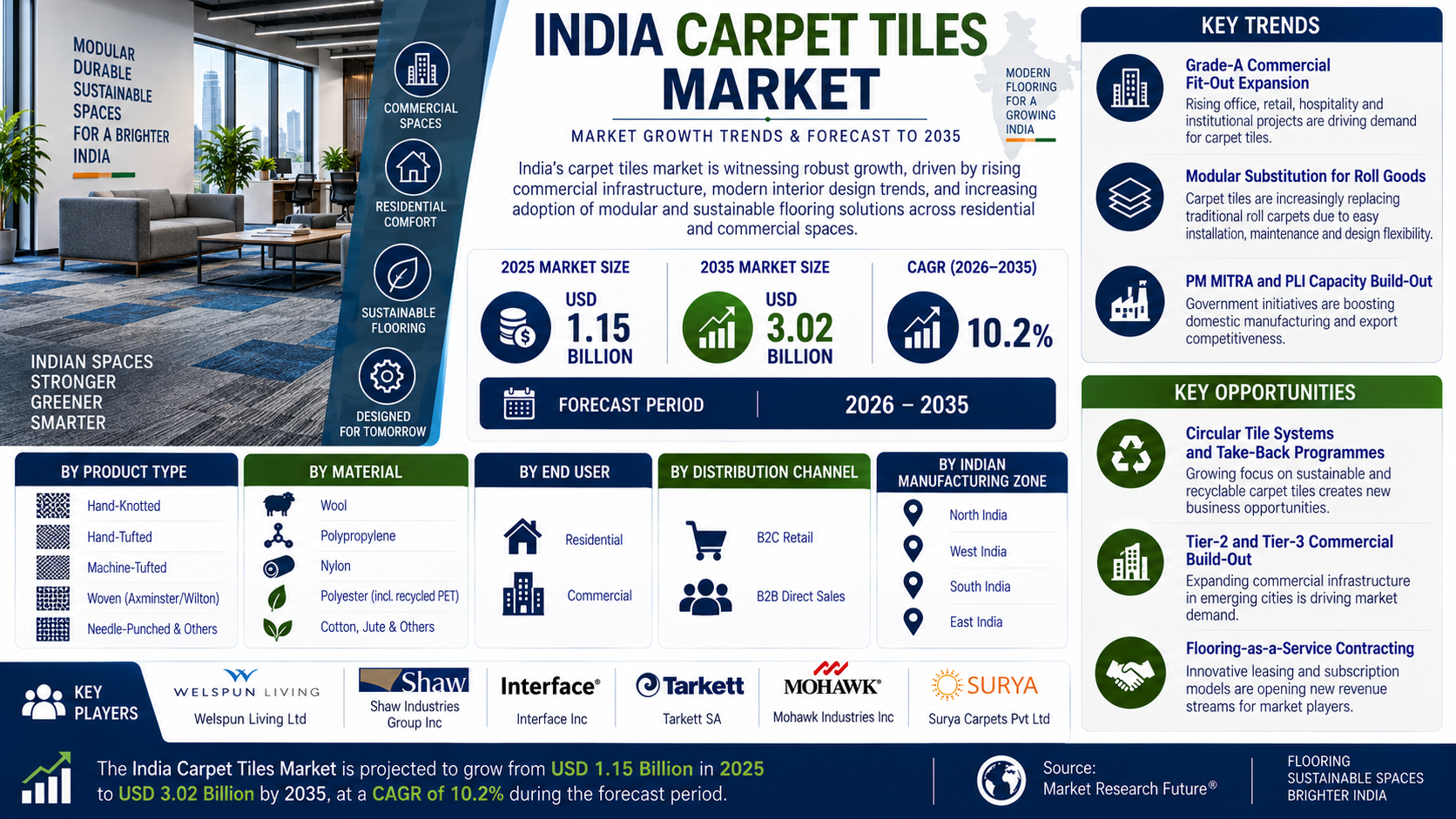

India’s carpet tiles market is expanding with commercial fit-outs, modular flooring adoption and new manufacturing capacity.
NY, UNITED STATES, September 17, 2026 /EINPresswire.com/ — The India carpet tiles market was valued at USD 1.15 Billion in 2025 and is projected to reach USD 3.02 Billion by 2035, registering a CAGR of 10.2% during the 2026–2035 forecast period, according to Market Research Future®. Growth is being supported by commercial construction, modular flooring adoption, manufacturing capacity expansion and increasing demand for flexible interior solutions.
Carpet tiles provide modular flooring solutions that can be installed, replaced and configured in sections rather than requiring the installation of large continuous rolls. This characteristic makes them relevant to commercial offices, hospitality environments, retail spaces, institutional buildings and selected residential applications.
The market encompasses hand-knotted, hand-tufted, machine-tufted, woven (Axminster/Wilton), needle-punched and other product types, with wool, polypropylene, nylon, polyester including recycled PET, cotton, jute and other materials serving different performance and design requirements.
Get Sample Report PDF| https://www.marketresearchfuture.com/sample_request/22220
Commercial Fit-Out Activity Supports Market Growth
Commercial construction is an important demand driver for carpet tiles in India. Grade-A commercial fit-outs require flooring systems that can support contemporary workplace layouts while providing practical maintenance and replacement options.
Modular carpet tiles can allow individual damaged or heavily used sections to be replaced without removing an entire floor covering. This characteristic can be valuable in offices, commercial buildings and other environments where maintenance needs to be managed without extensive disruption.
The expansion of premium commercial real estate can therefore create opportunities for carpet tile manufacturers, distributors, contractors and installation-service providers.
Modular Flooring Gains Ground Against Roll Goods
The shift from traditional roll goods toward modular flooring is an important trend in the Indian market.
Carpet tiles can provide flexibility in installation patterns, zoning and future replacement. Designers can also combine colors, textures and patterns to create differentiated areas within commercial interiors.
For businesses managing large facilities, modular replacement can potentially simplify maintenance by allowing localized interventions rather than replacing an entire floor covering.
This combination of installation flexibility and lifecycle practicality is supporting the adoption of carpet tiles across commercial applications.
Manufacturing Capacity Development Creates New Opportunities
India’s manufacturing ecosystem is expanding through initiatives aimed at strengthening domestic textile and technical-material production.
PM MITRA and PLI capacity build-out can support investment in manufacturing infrastructure and related supply chains. Increased domestic production capacity may improve access to locally manufactured flooring materials while creating opportunities for manufacturers to expand product portfolios.
For carpet tile producers, manufacturing scale can also support greater customization, shorter supply chains and improved responsiveness to commercial project requirements.
Product Technologies Serve Different Applications
The India carpet tiles market is segmented by product type into Hand-Knotted, Hand-Tufted, Machine-Tufted, Woven (Axminster/Wilton), and Needle-Punched & Others.
Hand-knotted and hand-tufted products can serve applications where craftsmanship, design and premium aesthetics are important. Machine-tufted products can support larger-volume applications where consistency and production efficiency are key considerations.
Woven products, including Axminster and Wilton constructions, can provide specialized performance and design characteristics. Needle-punched products and other formats can address additional commercial and functional flooring requirements.
Material Selection Is Becoming More Diverse
The market includes Wool, Polypropylene, Nylon, Polyester (including recycled PET), and Cotton, Jute & Others.
Wool can provide premium aesthetics and durability, while polypropylene offers material characteristics suited to cost-sensitive applications. Nylon is widely associated with durability and resilience in demanding environments.
Polyester, including recycled PET, provides an avenue for incorporating recycled feedstocks into flooring products. Growing attention to material sustainability can encourage manufacturers to explore recycled and alternative fibers.
Natural materials such as cotton and jute can provide additional design and material options for applications where texture and renewable-fiber characteristics are relevant.
Commercial Users Represent a Key Demand Base
The end-user segment is divided into Residential and Commercial applications.
Commercial projects can benefit from modular flooring because carpet tiles support flexible layouts and localized replacement. Offices, retail spaces, hospitality properties and institutional facilities can require flooring solutions that balance appearance, durability, maintenance and installation requirements.
Residential demand provides another application base, particularly where consumers seek customizable flooring designs or practical replacement options.
B2B Direct Sales Support Project-Based Procurement
Distribution channels in the market include B2C Retail and B2B Direct Sales.
B2B direct sales are particularly relevant for commercial projects where flooring requirements are specified during design and procurement processes. Manufacturers and suppliers can work directly with developers, architects, contractors, interior designers and facility managers.
Retail distribution can support residential consumers and smaller commercial requirements, providing access to products through established flooring and home-improvement channels.
The combination of project-based procurement and retail availability allows manufacturers to address different customer segments across the Indian market.
Regional Manufacturing Zones Shape Supply Development
The India carpet tiles market is segmented by manufacturing zone into North India, West India, South India and East India.
Regional manufacturing capacity can influence supply-chain efficiency, access to raw materials, labor availability and proximity to commercial construction markets.
As production capacity develops across different parts of India, manufacturers can potentially strengthen their ability to serve regional projects while expanding distribution networks nationally.
The geographic development of manufacturing also creates opportunities for regional suppliers and supporting industries involved in textile processing, flooring production and installation.
Circular Flooring Systems Create an Emerging Opportunity
Circular tile systems and take-back programmes represent an emerging opportunity for carpet tile manufacturers.
Modular flooring is naturally suited to selective replacement, refurbishment and material recovery because individual tiles can be removed without necessarily disturbing the entire installation.
Manufacturers can build on this characteristic by developing collection, refurbishment and recycling programs that extend product lifecycles and support more circular flooring models.
The use of recycled PET and other recycled materials can further support product-development strategies focused on resource efficiency.
Tier-2 and Tier-3 Cities Offer Expansion Potential
Commercial construction beyond India’s largest metropolitan markets can create new opportunities for carpet tile suppliers.
Tier-2 and Tier-3 cities are developing commercial buildings, business facilities, hospitality properties and institutional infrastructure. As modern workplace and interior-design standards expand into these markets, demand for modular and professionally installed flooring can increase.
For manufacturers and distributors, regional expansion can require stronger dealer networks, project partnerships and localized installation capabilities.
Flooring-as-a-Service Introduces a New Business Model
Flooring-as-a-service contracting provides another potential avenue for market development.
Under service-based models, businesses can shift from one-time flooring purchases toward arrangements that combine installation, maintenance, replacement and lifecycle management.
Carpet tiles can be suitable for such models because individual sections can be replaced as needed. This can allow service providers to manage flooring assets over longer periods while addressing changing workplace layouts and maintenance requirements.
Competitive Landscape
The India carpet tiles market includes domestic and international flooring and textile companies competing across product design, material selection, manufacturing capabilities, distribution and commercial project support.
Key players include Welspun Living Ltd, Shaw Industries Group Inc, Interface Inc, Tarkett SA, Mohawk Industries Inc and Surya Carpets Pvt Ltd.
Competition is influenced by product quality, design capabilities, manufacturing scale, project relationships, distribution reach, installation support and sustainability initiatives. Manufacturers are also exploring modular and circular approaches as customers increasingly evaluate flooring through both aesthetic and lifecycle considerations.
Outlook Through 2035
The India carpet tiles market is expected to continue expanding through 2035 as commercial fit-outs, modular flooring adoption and domestic manufacturing development support demand.
Grade-A commercial construction can create opportunities for premium modular flooring, while the substitution of carpet tiles for traditional roll goods can broaden their use across flexible commercial interiors.
PM MITRA and PLI capacity build-out can support domestic manufacturing and supply-chain development, while circular tile systems and take-back programmes may create new approaches to flooring lifecycle management.
Tier-2 and Tier-3 commercial development can further broaden the addressable market, while flooring-as-a-service contracting provides an emerging model for maintenance-focused customers.
The combination of commercial construction growth, modular product characteristics, manufacturing investment and circular flooring initiatives will remain important to the market’s development through 2035.
Read the full India Carpet Tiles Market Research Report:
https://www.marketresearchfuture.com/reports/india-carpet-tiles-market-22220
Forecast Period: 2026–2035
2025 Market Size: USD 1.15 Billion
2035 Market Size: USD 3.02 Billion
CAGR: 10.2%
Related Insights
Aluminum Market https://www.marketresearchfuture.com/reports/aluminum-market-2031
Specialty Lubricants Market https://www.marketresearchfuture.com/reports/specialty-lubricants-market-23663
Material Handling Equipment Market https://www.marketresearchfuture.com/reports/material-handling-equipment-market-3214
High Purity Silica Sand Market https://www.marketresearchfuture.com/reports/high-purity-silica-sand-market-47953
India Iron Steel Market https://www.marketresearchfuture.com/reports/india-iron-steel-market-21393
Sagar Kadam
Market Research Future
+1 628-258-0071
email us here
Legal Disclaimer:
EIN Presswire provides this news content “as is” without warranty of any kind. We do not accept any responsibility or liability
for the accuracy, content, images, videos, licenses, completeness, legality, or reliability of the information contained in this
article. If you have any complaints or copyright issues related to this article, kindly contact the author above.

Media gallery